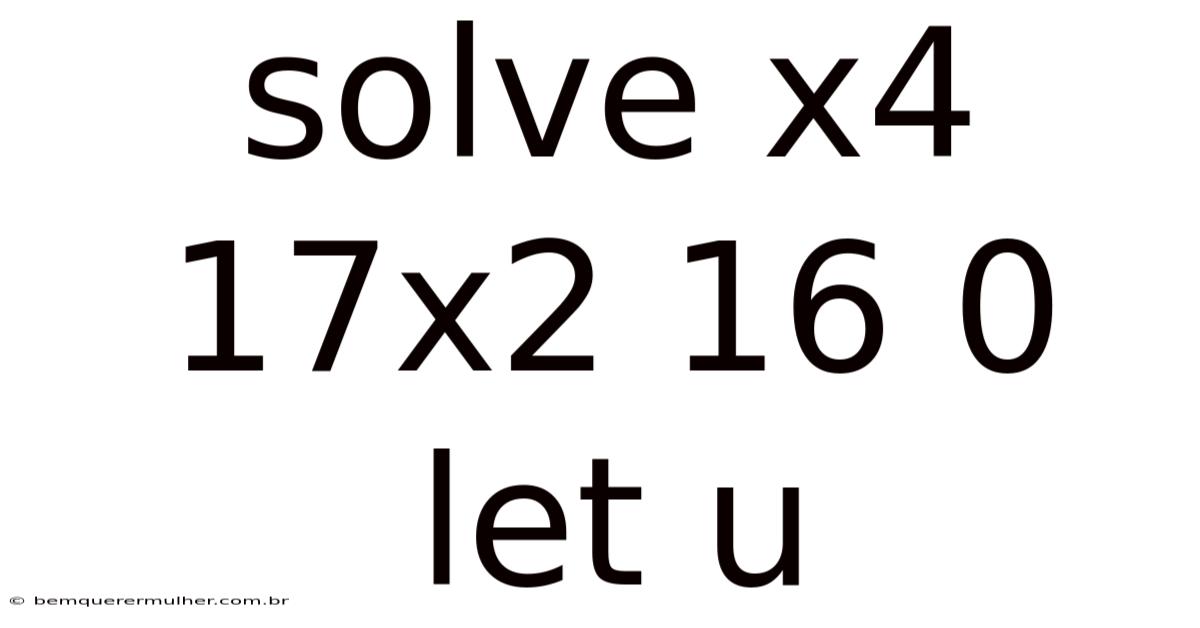
Solve the quartic equation (x^{4}+17x^{2}+16=0) by using the substitution (u=x^{2})
The quartic polynomial (x^{4}+17x^{2}+16) looks intimidating at first glance, but a simple change of variable turns it into a familiar quadratic that can be solved in seconds. Now, in this article we walk through every step of the method, explain why the substitution works, explore alternative solution paths, and answer the most common questions that arise when students encounter this type of problem. By the end, you will be able to solve not only this particular equation but also any quartic that can be reduced to a quadratic in (x^{2}).
Introduction: Why a substitution helps
A quartic equation is any polynomial of degree four. Solving a generic quartic requires lengthy formulas that are rarely taught outside advanced algebra courses. In its general form it contains terms (x^{4}, x^{3}, x^{2}, x) and a constant. Fortunately, many quartics are bi‑quadratic, meaning they contain only even powers of (x).
[ x^{4}+17x^{2}+16=0 ]
Because the odd‑power terms (x^{3}) and (x) are missing, the expression can be rewritten in terms of (x^{2}) alone. This observation suggests the substitution
[ u = x^{2}\qquad\Longrightarrow\qquad u^{2}=x^{4}. ]
With this change, the original equation collapses to a quadratic in the new variable (u). Quadratics are taught in every high‑school curriculum, and we have a reliable toolbox (factoring, completing the square, quadratic formula) to solve them quickly Less friction, more output..
Step‑by‑step solution using (u=x^{2})
1. Perform the substitution
Replace every occurrence of (x^{4}) with (u^{2}) and every occurrence of (x^{2}) with (u):
[ x^{4}+17x^{2}+16=0 ;\Longrightarrow; u^{2}+17u+16=0. ]
Now we have a standard quadratic equation in (u).
2. Solve the quadratic for (u)
Factoring method
Look for two numbers whose product is (16) and whose sum is (17). The pair (1) and (16) fits:
[ u^{2}+17u+16=(u+1)(u+16)=0. ]
Thus
[ u+1=0 \quad\text{or}\quad u+16=0, ] [ \boxed{u=-1\quad\text{or}\quad u=-16}. ]
Quadratic‑formula check
If factoring were not obvious, the quadratic formula would give the same result:
[ u=\frac{-17\pm\sqrt{17^{2}-4\cdot1\cdot16}}{2} =\frac{-17\pm\sqrt{289-64}}{2} =\frac{-17\pm\sqrt{225}}{2} =\frac{-17\pm15}{2}, ]
yielding (u=-1) and (u=-16) again.
3. Back‑substitute (u=x^{2})
Recall that (u=x^{2}). Replace (u) with (x^{2}) in each solution:
[ x^{2} = -1 \qquad\text{or}\qquad x^{2} = -16. ]
4. Solve for (x)
Both right‑hand sides are negative, indicating complex solutions. Taking square roots:
-
From (x^{2}=-1):
[ x = \pm i. ]
-
From (x^{2}=-16):
[ x = \pm 4i. ]
Collecting all four roots:
[ \boxed{x = \pm i,; \pm 4i }. ]
These are the complete solutions in the complex plane. No real solutions exist because the original polynomial is always positive for real (x) (the sum of two non‑negative terms plus a positive constant).
Scientific explanation: Why the substitution works
The substitution (u=x^{2}) exploits the even symmetry of the polynomial. Now, a function (f(x)) is even if (f(-x)=f(x)). For even functions, the variable appears only with even powers, allowing us to treat (x^{2}) as a single entity.
Mathematically, the mapping
[ \phi : \mathbb{C}\to\mathbb{C},\qquad \phi(x)=x^{2}, ]
is a two‑to‑one function: each non‑zero (u) corresponds to two opposite values of (x) (namely (\pm\sqrt{u})). By solving for (u) first, we reduce the problem to a simpler algebraic structure, then lift the solutions back to the original variable using the inverse mapping (square root). This technique is a special case of reduction of degree, a powerful strategy in algebra Took long enough..
Alternative methods (for completeness)
1. Direct factoring of the quartic
Sometimes the quartic can be factored without substitution:
[ x^{4}+17x^{2}+16 = (x^{2}+1)(x^{2}+16). ]
Expanding the right‑hand side confirms the equality:
[ (x^{2}+1)(x^{2}+16)=x^{4}+16x^{2}+x^{2}+16 = x^{4}+17x^{2}+16. ]
Setting each factor to zero yields the same solutions as before. This factorisation is essentially the same as the substitution method, just expressed in the original variable.
2. Using the quadratic formula on the “hidden” quadratic
If a student does not notice the even powers, they might still rewrite the equation as
[ x^{4}+17x^{2}+16=0 \quad\Longrightarrow\quad (x^{2})^{2}+17(x^{2})+16=0, ]
and then apply the quadratic formula directly to the expression ((x^{2})). This is conceptually identical to the substitution approach, but it emphasizes that the quadratic formula works on any expression squared, not only on a simple variable.
3. Graphical insight
Plotting (y=x^{4}+17x^{2}+16) over the real axis shows a curve that never dips below the (x)-axis, confirming the absence of real roots. The minimum occurs at (x=0) with value (16). The complex roots we found lie on the imaginary axis, symmetric about the origin, which matches the even nature of the polynomial Less friction, more output..
Frequently Asked Questions (FAQ)
Q1. Why are there no real solutions?
A: For any real number (x), both (x^{4}) and (x^{2}) are non‑negative. Adding the positive constant (16) guarantees the entire expression is > 0. Hence the equation cannot be satisfied by a real (x) It's one of those things that adds up. But it adds up..
Q2. Could we have used (u = x^{4}) instead?
A: Substituting (u = x^{4}) would give (u + 17x^{2} + 16 = 0), which still contains the mixed term (x^{2}). The substitution would not eliminate the variable completely, so it does not simplify the problem.
Q3. What if the constant term were negative, e.g., (x^{4}+17x^{2}-16=0)?
A: The same substitution works, leading to (u^{2}+17u-16=0). Factoring gives ((u+16)(u-1)=0), so (u=1) or (u=-16). Back‑substituting yields real roots (x=\pm1) and complex roots (x=\pm4i).
Q4. Is the method applicable to higher even powers, such as (x^{6}+5x^{3}+6=0)?
A: Only when the polynomial contains only even powers (or only odd powers that share a common factor). The example (x^{6}+5x^{3}+6) mixes degrees 6, 3, and 0, so a simple (u=x^{2}) substitution does not work. Even so, you could try (u=x^{3}) because the powers are multiples of 3, reducing it to a quadratic in (u) Simple as that..
Q5. How do we know which substitution to choose?
A: Look for the greatest common divisor (GCD) of the exponents. If all exponents are multiples of (k), set (u = x^{k}). For the given equation the exponents are (4) and (2); their GCD is (2), leading to (u = x^{2}).
Common pitfalls and how to avoid them
| Pitfall | Why it happens | How to prevent it |
|---|---|---|
| Forgetting the “±” when taking square roots | Students often write (x = \sqrt{-1}) instead of (x = \pm i). That said, | |
| Assuming real solutions exist because the equation is “zero” | The word “solve” can be misinterpreted as “find real numbers”. | |
| Mixing up the variable after substitution | After solving for (u), some students keep using (x) in the quadratic formula. | Scan the polynomial for missing odd powers; if they are absent, write it as ((x^{2})^{2}+... |
| Trying to factor the quartic directly without recognizing the bi‑quadratic pattern | Without the pattern, factoring looks random. Think about it: | Remember that any equation (x^{2}=a) (with (a\neq0)) has two solutions: (x = \pm\sqrt{a}). |
Conclusion
The equation
[ x^{4}+17x^{2}+16=0 ]
is a textbook example of a bi‑quadratic polynomial that collapses to a quadratic when we set (u=x^{2}). By following the systematic steps—substitution, quadratic solution, back‑substitution, and square‑root extraction—we obtain the four complex roots (x=\pm i) and (x=\pm4i). The method showcases a powerful algebraic principle: reducing the degree of a polynomial by exploiting common exponent factors.
Understanding this technique equips you to tackle a wide class of higher‑degree equations, saves time during exams, and deepens your appreciation of the structure hidden inside seemingly complicated expressions. Whenever you see a polynomial that contains only even (or only odd) powers, pause, compute the GCD of the exponents, and let that guide your substitution. The path from a daunting quartic to a simple quadratic will then appear almost automatically.
It sounds simple, but the gap is usually here.
