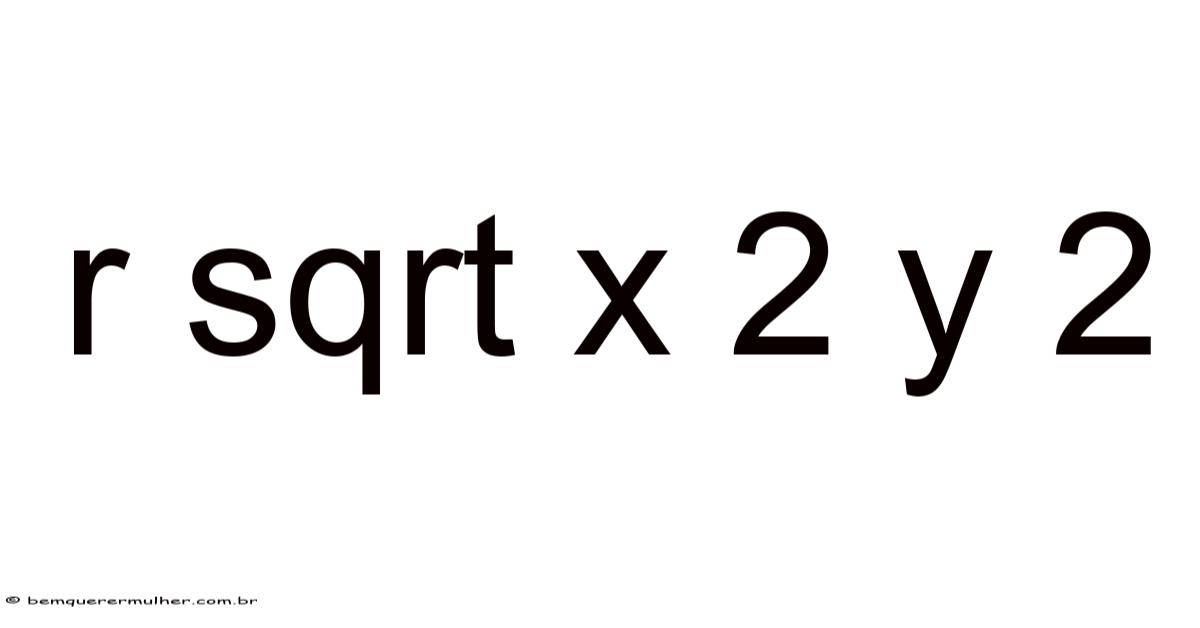
Understanding the Relationship Between Cartesian and Polar Coordinates: Why ( r = \sqrt{x^2 + y^2} )
When you first encounter the formula ( r = \sqrt{x^2 + y^2} ), it may look like a simple algebraic identity, but it actually encapsulates a fundamental bridge between two ways of describing points in a plane: Cartesian (rectangular) coordinates ((x, y)) and polar coordinates ((r, \theta)). This article will unpack the meaning of the formula, explore its derivation, discuss its practical applications, and answer common questions that arise when learning about this essential concept in geometry and trigonometry.
Introduction
In everyday life, we often describe positions using a grid: the familiar (x)-axis (horizontal) and (y)-axis (vertical). This is the Cartesian coordinate system. On the flip side, many problems—especially those involving rotation, circular motion, or symmetry—are more naturally expressed in terms of a distance from a central point and an angle. This is where the polar coordinate system comes in, using a radial distance (r) and an angular coordinate (\theta).
The equation ( r = \sqrt{x^2 + y^2} ) is the key that translates between these two systems. Here's the thing — it tells us how far a point is from the origin, given its Cartesian coordinates. Understanding this relationship is crucial for solving problems in physics, engineering, computer graphics, and many branches of mathematics Worth keeping that in mind..
The Pythagorean Connection
Visualizing the Point
Consider a point (P) in the plane with Cartesian coordinates ((x, y)). Draw a right triangle that has:
- One leg along the (x)-axis from the origin ((0,0)) to ((x,0)).
- Another leg along the (y)-axis from ((x,0)) to ((x,y)).
- The hypotenuse from the origin ((0,0)) to the point (P).
The length of the hypotenuse is exactly the radial distance (r) in polar coordinates. By the Pythagorean theorem, the square of the hypotenuse equals the sum of the squares of the two legs:
[ r^2 = x^2 + y^2. ]
Taking the positive square root (since distance cannot be negative) gives the familiar formula:
[ \boxed{,r = \sqrt{x^2 + y^2},}. ]
Why the Square Root?
The square root appears because we are solving for the hypotenuse length (r) when we know the squares of the other two sides. The theorem states (a^2 + b^2 = c^2). Solving for (c) requires taking the square root of both sides. In the context of coordinates, (a = |x|) and (b = |y|), so the distance from the origin to the point ((x, y)) is always non‑negative Easy to understand, harder to ignore..
Converting Between Coordinate Systems
From Cartesian to Polar
Given ((x, y)), we can find ((r, \theta)) using:
- Radius:
[ r = \sqrt{x^2 + y^2}. ] - Angle:
[ \theta = \arctan2(y, x), ] where (\arctan2) is the two‑argument arctangent that correctly accounts for the quadrant of the point.
From Polar to Cartesian
Conversely, given ((r, \theta)), we compute:
[ x = r \cos\theta,\qquad y = r \sin\theta. ]
These two sets of equations are inverses of each other. They form the backbone of many algorithms in computer graphics, robotics, and navigation Worth keeping that in mind. Practical, not theoretical..
Practical Applications
| Field | How ( r = \sqrt{x^2 + y^2} ) Helps |
|---|---|
| Physics | Describing radial forces (e.And g. , gravity, electric fields) that depend on distance from a source. |
| Engineering | Calculating cable lengths, structural spans, or heat diffusion from a point source. |
| Computer Graphics | Converting between screen coordinates (Cartesian) and radial gradients or circular patterns. |
| Navigation | Determining straight‑line distance between two geographic points when approximated in a planar map. |
| Robotics | Path planning for robots that move in circular arcs or need to maintain a fixed radius from an obstacle. |
Common Misconceptions
-
“(r) can be negative.”
In polar coordinates, the radius (r) is conventionally taken as non‑negative. A negative radius would imply a point in the opposite direction, which is already handled by the angle (\theta). So we always use (r \ge 0) Worth keeping that in mind.. -
“The formula only works for points in the first quadrant.”
The derivation uses (x^2) and (y^2), which are always non‑negative regardless of the sign of (x) or (y). Thus, the formula is valid for any point in the plane. -
“(\arctan(y/x)) is enough to find (\theta).”
The simple arctangent loses quadrant information. The (\arctan2(y, x)) function preserves it, ensuring the correct angle between (-\pi) and (\pi) Small thing, real impact..
Extending the Concept: Three Dimensions
In three‑dimensional space, the distance from the origin to a point ((x, y, z)) is given by:
[ r = \sqrt{x^2 + y^2 + z^2}. ]
This is the generalization of the planar formula and is fundamental in spherical coordinates, where (r) is the radial distance, (\theta) is the inclination (from the positive (z)-axis), and (\phi) is the azimuth (angle in the (xy)-plane) Easy to understand, harder to ignore..
Frequently Asked Questions
| Question | Answer |
|---|---|
| Why do we square (x) and (y) before adding? | Squaring ensures both terms are positive, allowing the sum to represent the square of the distance. |
| **Can we use this formula for complex numbers?That said, ** | Yes. Now, for a complex number (z = x + iy), the magnitude ( |
| What if (x) and (y) are functions of time? | Then (r(t) = \sqrt{[x(t)]^2 + [y(t)]^2}) gives the radial distance as a function of time, useful for analyzing motion. Here's the thing — |
| **How does this relate to the unit circle? Think about it: ** | On the unit circle, (r = 1). That's why thus, any point ((\cos\theta, \sin\theta)) satisfies (\sqrt{\cos^2\theta + \sin^2\theta} = 1). Worth adding: |
| **Is there a geometric proof without the Pythagorean theorem? On the flip side, ** | One can use the law of cosines on the triangle formed by the origin, the point, and the projection onto the (x)-axis. The result collapses to the same formula. |
Some disagree here. Fair enough.
Conclusion
The expression ( r = \sqrt{x^2 + y^2} ) is more than a quick shortcut; it is a gateway to a deeper understanding of how we measure space. By bridging Cartesian and polar representations, it unlocks simpler solutions to problems involving symmetry, rotation, and radial dependence. Mastering this formula empowers students and professionals alike to figure out between coordinate systems with confidence, paving the way for advanced exploration in mathematics, physics, engineering, and beyond.
Beyond the classroom, the relationship underpins many real‑world calculations, from determining the magnitude of forces in mechanics to analyzing the amplitude of waves in optics. In signal processing, the same expression quantifies the strength of a complex signal, while in computer graphics it guides the scaling of textures and the computation of lighting effects. Worth adding, the concept extends naturally to higher‑dimensional data, where the Euclidean norm generalizes the idea of distance in multidimensional spaces. Thus, the simple expression (r = \sqrt{x^2 + y^2}) remains a cornerstone of spatial reasoning across disciplines.
