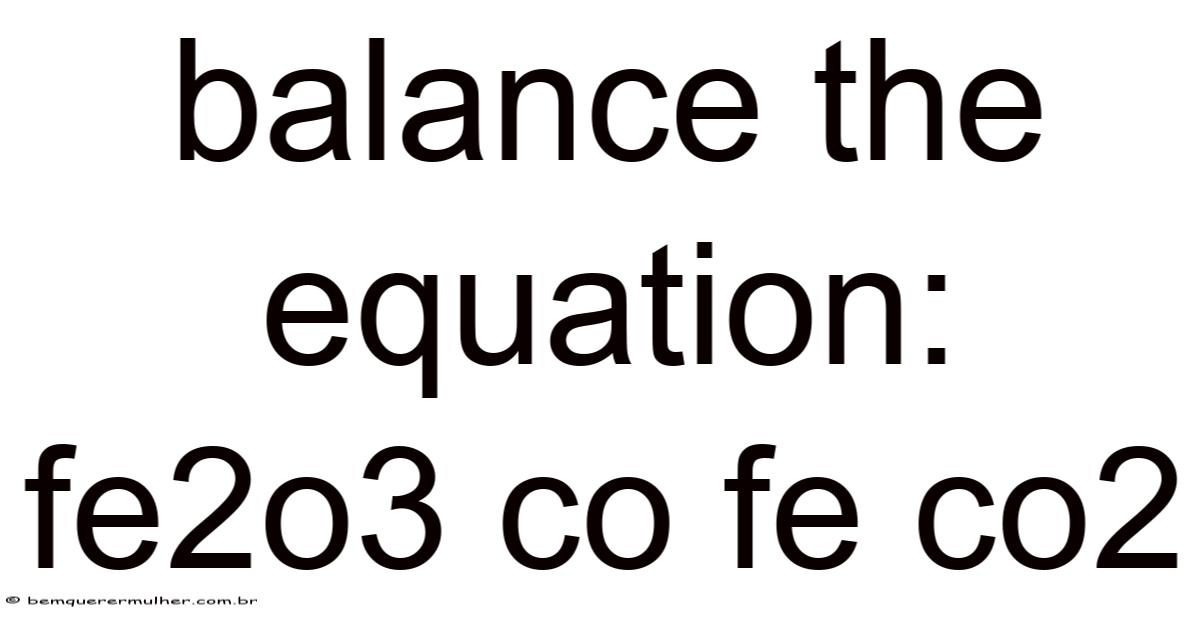
Balancing the Chemical Equation: Fe₂O₃ + CO → Fe + CO₂
Chemical equations represent the transformation of reactants into products, and balancing them ensures the law of conservation of mass is upheld. One such equation that often puzzles students is Fe₂O₃ + CO → Fe + CO₂, where iron(III) oxide reacts with carbon monoxide to produce iron and carbon dioxide. Understanding how to balance this equation not only reinforces stoichiometric principles but also provides insight into industrial chemistry. This reaction is a critical step in metallurgical processes, particularly in the extraction of iron from its ore. Let’s explore the step-by-step process to balance this equation and its broader significance.
Step-by-Step Process to Balance the Equation
-
Write the Unbalanced Equation
Begin with the skeletal equation:
Fe₂O₃ + CO → Fe + CO₂ -
Count Atoms on Each Side
- Left Side:
- Iron (Fe): 2
- Oxygen (O): 3 (from Fe₂O₃) + 1 (from CO) = 4
- Carbon (C): 1
- Right Side:
- Iron (Fe): 1
- Oxygen (O): 2 (from CO₂)
- Carbon (C): 1
Clearly, the equation is unbalanced. Let’s adjust coefficients to equalize atoms That alone is useful..
- Left Side:
-
Balance Iron (Fe) First
There are 2 Fe atoms in Fe₂O₃ on the left. To balance Fe, place a coefficient of 2 in front of Fe on the right:
Fe₂O₃ + CO → 2Fe + CO₂ -
Balance Carbon (C) Next
There is 1 C atom in CO on the left and 1 C in CO₂ on the right. To balance C, place a coefficient of 2 in front of CO and CO₂:
Fe₂O₃ + 2CO → 2Fe + 2CO₂ -
Check Oxygen (O) Atoms
- Left Side: 3 (from Fe₂O₃) + 2×1 (from 2CO) = 5 O atoms
- Right Side: 2×2 (from 2CO₂) = 4 O atoms
Oxygen is still unbalanced. Adjust the coefficient of CO to 3 and CO₂ to 3:
Fe₂O₃ + 3CO → 2Fe + 3CO₂
-
Final Verification
- Fe: 2 on both sides.
- C: 3 on both sides.
- O: 3 (Fe₂O₃) + 3×1 (3CO) = 6 on the left; 3×2 (3CO₂) = 6 on the right.
The equation is now balanced.
Scientific Explanation of the Reaction
This reaction is a redox process where iron(III) oxide undergoes reduction, and carbon monoxide acts as a reducing agent. Here’s the breakdown:
-
Reduction Half-Reaction:
Fe³⁺ in Fe₂O₃ gains electrons to form Fe⁰:
Fe₂O₃ + 6e⁻ → 2Fe + 3O²⁻ -
Oxidation Half-Reaction:
C in CO loses electrons to form CO₂:
CO → CO₂ + 2e⁻
Combining these half-reactions and balancing electrons yields the overall reaction:
**Fe₂
Combining these half-reactions and balancing electrons yields the overall reaction:
Fe₂O₃ + 3CO → 2Fe + 3CO₂
This elegant balance reflects the transfer of electrons from carbon (oxidation state +2 in CO) to iron (oxidation state +3 in Fe₂O₃), resulting in elemental iron (oxidation state 0) and carbon dioxide (oxidation state +4 in CO₂). The stoichiometric coefficients confirm that every electron lost by carbon is gained by iron, maintaining charge conservation alongside mass conservation And that's really what it comes down to..
Industrial Significance
This reaction is not merely an academic exercise—it forms the backbone of the blast furnace process used worldwide in iron and steel production. In a blast furnace, iron ore (primarily Fe₂O₃) is mixed with coke (carbon) and hot air is blown through the mixture. Consider this: the coke undergoes incomplete combustion to produce carbon monoxide (CO), which then reduces the iron oxide to molten iron. The reaction we have balanced represents the essential chemical transformation occurring within these massive industrial reactors Most people skip this — try not to..
The efficiency of this process depends heavily on maintaining the proper ratio of reducing agent (CO) to iron ore. Too little CO results in incomplete reduction, while excess CO represents wasted fuel and energy. This is why understanding the stoichiometry is crucial for metallurgical engineers seeking to optimize production while minimizing costs and environmental impact Easy to understand, harder to ignore..
Most guides skip this. Don't Most people skip this — try not to..
Environmental and Economic Considerations
The iron and steel industry is one of the largest consumers of energy and emitters of carbon dioxide globally. Every ton of steel produced generates approximately 1.8 tons of CO₂, primarily from the reduction reactions in blast furnaces. This has spurred significant research into alternative reducing agents and processes, such as using hydrogen (green hydrogen produced from renewable sources) to directly reduce iron ore, which would produce water (H₂O) instead of CO₂ as a byproduct.
On the flip side, the fundamental stoichiometric principles remain unchanged regardless of the reducing agent used. Balancing equations like Fe₂O₃ + CO → Fe + CO₂ equips future chemists and engineers with the foundational skills needed to tackle more sustainable metallurgical processes and innovate new solutions for a greener industry Nothing fancy..
Conclusion
Balancing the equation Fe₂O₃ + 3CO → 2Fe + 3CO₂ is more than a textbook exercise—it is a window into the chemistry that shapes our modern world. Now, from the extraction of iron from its ore to the production of steel that builds our cities, this reaction exemplifies the importance of stoichiometry in industrial processes. By mastering these fundamental principles, students and professionals alike gain the ability to understand, optimize, and ultimately transform the chemical processes that sustain modern civilization. As the world moves toward more sustainable industrial practices, the lessons learned from balancing simple equations will continue to guide innovation in metallurgy and beyond.
From Laboratory Balance to IndustrialScale
The simplicity of the balanced equation belies the complexity of its implementation on an industrial scale. In a modern blast furnace, dozens of chemical and physical processes occur simultaneously:
- Gas‑solid heat transfer – the hot CO and N₂ gases travel upward, delivering thermal energy that drives endothermic reduction steps.
- Phase changes – iron ore is first dried, then partially melted as it descends, forming a slurry of molten iron and slag that collects at the hearth.
- Mass‑transfer limitations – diffusion of CO into porous ore particles governs the rate at which Fe₂O₃ is reduced, often requiring a finer particle size or higher gas velocity to achieve the desired throughput. Engineers address these challenges by continuously monitoring key parameters—temperature profile, CO concentration, and slag composition—using sophisticated sensor networks and real‑time data analytics. Advanced process‑control algorithms adjust the injection of auxiliary fuels (such as natural gas or oxygen‑enriched air) to keep the CO/Fe₂O₃ ratio within a narrow optimal window, thereby maximizing iron yield while minimizing coke consumption.
Alternative Reducing Agents and Their Stoichiometry
While CO remains the dominant reducer in traditional blast furnaces, emerging technologies explore different pathways that rely on the same stoichiometric logic:
| Reducing Agent | Primary Reaction with Fe₂O₃ | By‑product | Stoichiometric Coefficient |
|---|---|---|---|
| Hydrogen (H₂) | Fe₂O₃ + 3 H₂ → 2 Fe + 3 H₂O | Water vapor | 3 mol H₂ per 1 mol Fe₂O₃ |
| Methane (CH₄) | Fe₂O₃ + 3 CH₄ → 2 Fe + 3 CO + 6 H₂ | CO + H₂ (syngas) | Complex; often requires reforming steps |
| Electro‑reduction (electric arc) | Fe₂O₃ + 3 e⁻ → 2 Fe + 3 O²⁻ | O²⁻ (captured in slag) | Electron count equivalent to 3 mol e⁻ |
Each alternative reaction can be balanced using the same systematic approach demonstrated earlier. To give you an idea, the hydrogen reduction is elegantly simple:
[\text{Fe}_2\text{O}_3 + 3,\text{H}_2 ;\longrightarrow; 2,\text{Fe} + 3,\text{H}_2\text{O} ]
Because water vapor leaves the system as a benign gas, hydrogen offers a direct route to decarbonizing ironmaking—provided that the hydrogen is produced via electrolysis powered by renewable electricity (the so‑called “green hydrogen” scenario). The stoichiometric coefficient of 3 mol H₂ per mole of Fe₂O₃ serves as a clear benchmark for plant designers when sizing reactors, heat exchangers, and gas‑handling equipment.
Computational Tools for Stoichiometric Optimization
Modern metallurgical research increasingly relies on computational chemistry and process simulation platforms (e.Plus, g. , Aspen HYSYS, COMSOL Multiphysics, and custom Python scripts) to predict reaction extents, equilibrium compositions, and energy balances That's the part that actually makes a difference..
- Define species and elemental balances – input chemical formulas for all reactants and products.
- Set up linear equations – each element yields one linear equation; solve using matrix algebra.
- Incorporate thermodynamic data – Gibbs free energy functions dictate the direction and extent of each reaction at given temperatures.
- Run sensitivity analyses – vary the CO/Fe₂O₃ ratio, temperature, or pressure to locate optimal operating windows.
Such automation not only reduces human error in manual balancing but also enables rapid exploration of “what‑if” scenarios—such as substituting 20 % of the coke with bio‑char or integrating a CO₂‑recycling loop—thereby accelerating the development of next‑generation ironmaking processes Nothing fancy..
Linking Stoichiometry to Sustainability Metrics
The ultimate goal of balancing reactions is to translate chemical insight into quantifiable sustainability outcomes. By applying stoichiometric constraints to life‑cycle assessments (LCAs), engineers can calculate:
- CO₂ emissions per tonne of iron – derived from the carbon content of the reducing agent and the stoichiometric yield of CO₂.
- Energy intensity (MJ t⁻¹) – obtained by summing the enthalpy changes of each reaction step, adjusted for furnace inefficiencies. * Resource efficiency – expressed as the ratio of useful iron produced to the mass of raw material fed, directly tied to the limiting reagent concept.
To give you an idea, if a plant switches from coal‑derived CO to green hydrogen, the stoichiometric coefficient of 3 mol H₂ per mole of Fe₂O₃ implies that three moles of electrons (or equivalently, three moles of H₂) are needed for each mole of ore reduced. When the hydrogen is produced via water electrolysis powered by wind energy, the associated CO₂ footprint drops from roughly 1.8 t CO₂ t⁻¹
CO₂ per tonne of iron to near-zero, underscoring the transformative potential of renewable energy integration. Even so, such transitions are not without challenges: green hydrogen production remains energy-intensive, and scaling infrastructure to meet global demand requires careful planning.
Beyond emissions, stoichiometric precision also informs material recycling strategies. Take this case: optimizing the Fe₂O₃-to-H₂ ratio minimizes unreacted feedstock, reducing waste streams and lowering raw material costs. Similarly, balancing reactions in downstream steelmaking—such as the carbothermal reduction of iron ore—enables plants to fine-tune carbon usage and limit excess CO release.
As the industry edges toward circular economy principles, these stoichiometric insights become critical for designing closed-loop systems where by-products like CO₂ or water are captured, reused, or sequestered. In the long run, mastering the chemistry of iron reduction—from lab-scale equations to industrial-scale reactors—is not just about efficiency; it’s about securing a sustainable foundation for one of the world’s most essential materials.
